
Original post March 01, 2016 | Updated by Alannah Baptista, November 16, 2026
Twin Creek Media first wrote this post in 2016. Some of it has aged like a good Okanagan red, and some of it has aged like a phone from 2016. A tourism website is your online front desk; the place guests check, compare and book your hotel, tour, rental or attraction. For Okanagan tourism operators, it means more direct bookings and fewer repeat questions. Here is what to know and how to apply it.
As the nearly official Napa of the North, with a sprawling, sun-drenched lake in our backyard, Kelowna is home to dozens of businesses in the tourism industry. In this niche, Okanagan websites have to be true workhorses: attracting, welcoming, enticing, informing, reserving, socializing, and even goodbye-ing today’s tech-savvy tourists.
The good parts still hold. Guests still want to feel something in the first few seconds, and they still want an easy way to book. What’s changed is everything around it. Phones run the show, Google ranks the mobile version of your site, and travellers now get answers from AI tools before they ever click.
What Makes a Tourism Website Book More Guests?
- Make people want it in seconds. Real photos and short video of your experience belong on the very first screen.
- Give every page one clear “Book Now” button, and make sure it works with one thumb on a phone.
- Build for phones first. Across four of our tourism clients, phones drove 60% to 77% of website sessions over the past year.
- Make it easy for happy guests to share, tag and review you.
- Measure bookings and calls, and where they came from, so your budget goes to what works.
“A good place to start is how you perceive your tourism business website. Hint: it’s not just a brochure! Fundamentally, your Kelowna website should be part of your well-trained guest services team. Think of your best staff. How can you make your website more like them? Friendly, patient, helpful, answer questions… always selling, but not in a pushy way.”
— James Shaw, Founder and CEO, Twin Creek Media
That was true in 2016. In 2026, your best staff member also works nights, weekends and the whole off-season, from a screen that fits in a pocket.
Here are our top tips for capturing more guests, more bookings, more RSVPs, and great word of mouth.
1. Create a Powerful and Instant Emotional Appeal
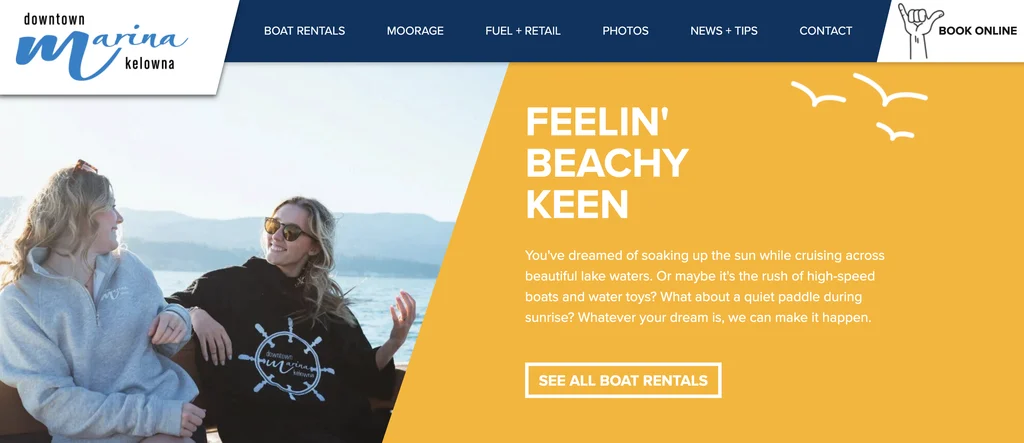
You want people to subconsciously think, “Yes, I want this!” within seconds of landing on your site. Stunning visuals do that job. When we first wrote this post, the first screen of the Downtown Marina website said it all: you + high-speed boat + expansive beautiful lake and romantic waterfront = an amazing time.
Any website should make it immediately clear what your business offers. A tourism website also has to create a longing for your experience. How do you do that?
- Use real, high-resolution photos of your landscape and of people enjoying themselves. Stock photos of someone else’s lake won’t sell yours.
- Add short video. A 20 to 30 second clip takes guests “inside your doors” faster than any paragraph can. Our video production and photography teams shoot this for clients across the Okanagan.
- Pick colours that reflect your brand and set the mood: muted tones for relaxing, bright hues for adventure.
- Keep it light. Compress large photos and video so that first screen still loads fast on a phone with two bars of signal.
2. Ask Site Visitors To Take the Next Step
There’s a saying that people hate to be sold, but they love buying. Your website should help people buy, not hinder them. It’s a fact of human nature: ask people to do something, and they probably will. Okanagan tourism websites need clear calls to action (CTAs) that ask visitors to view rentals, book lessons, or reserve a paddleboard.
Here’s what we’d do in 2026:
- Use one main CTA per page. “Book Now” works better alone than squeezed between “Call Us,” “Sign Up” and “Follow Us.”
- Put it where thumbs reach. A sticky “Book Now” button on mobile stays visible while people scroll.
- Connect your booking software so guests can check availability and pay without leaving your site.
- Answer the questions that stall a booking: price, what’s included, what to bring, and your cancellation policy. Every unanswered question becomes an abandoned cart or a 9 pm phone call.
A quick word on direct bookings. Third-party booking sites can fill seats, but they typically charge a commission on every sale. Most operators we work with use both. The goal is to make your own site the easiest place to book, so more of each booking stays with you.
3. Make Sure Your Design Is Responsive
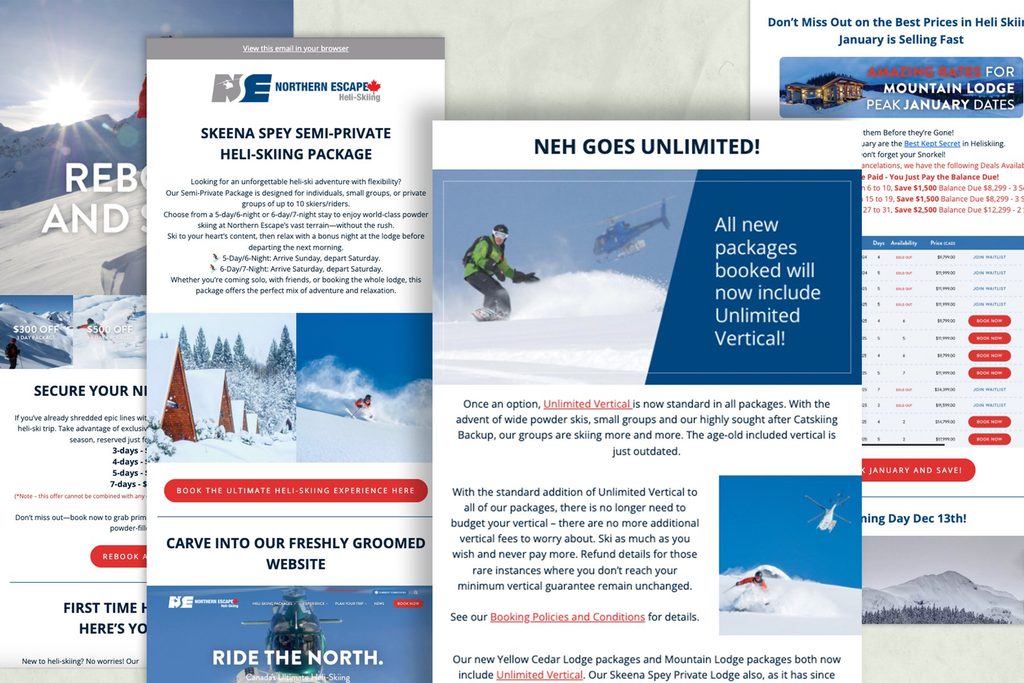
Desktop, laptop, tablet or phone: make it pretty, helpful, and fast on all devices, and your guests will love you. Tourists plan a lot of their trip well in advance, but many like the freedom to change plans as they go, staying a day longer if they find a spot they love.
Picture a family crossing the bridge into Kelowna, with someone in the back seat searching “things to do in Kelowna today” on 12% battery. That’s your customer. If your site takes forever to load or hides the booking button, they’ll book the next result before the battery dies.
In 2016, we wrote that our Kelowna area tourism clients saw 50% to 60% of their traffic from mobile, and that it was EXTREMELY CRITICAL your website works flawlessly on phones. Ten years later, we’d like to add a few more capital letters.
| Year | Share of website sessions from phones | Source |
|---|---|---|
| 2016 | 50% to 60% | TCM’s Kelowna area tourism clients (original post) |
| Nov 2025 to Oct 2026 | 60% to 77% | Google Analytics 4 data from four TCM tourism clients |
Google cares too. It uses the mobile version of your site’s content for indexing and ranking. If your phone layout hides your rates or your booking button, Google sees a weaker page.
Let’s say someone Googles “Kelowna hotels” on their phone. With a responsive website (one that adjusts to the visitor’s screen), they can get the info they need and tap “Book Now” or click to call right away. A fast map and directions link scores bonus points with your guests.
Speed is part of “working” on a phone. Google’s Core Web Vitals give you three numbers to check:
| Metric | What it measures | “Good” target |
|---|---|---|
| Largest Contentful Paint (LCP) | How fast the main content shows up | 2.5 seconds or less |
| Interaction to Next Paint (INP) | How fast the page reacts when someone taps | 200 milliseconds or less |
| Cumulative Layout Shift (CLS) | Whether buttons jump around while loading | 0.1 or less |
Learn more about why responsive design matters in our post 5 Reasons to Redesign Your Site Now. Our tourism website design work is built around these criteria, making it faster and easier for your audience to book!
4. Ask Visitors To Get Social
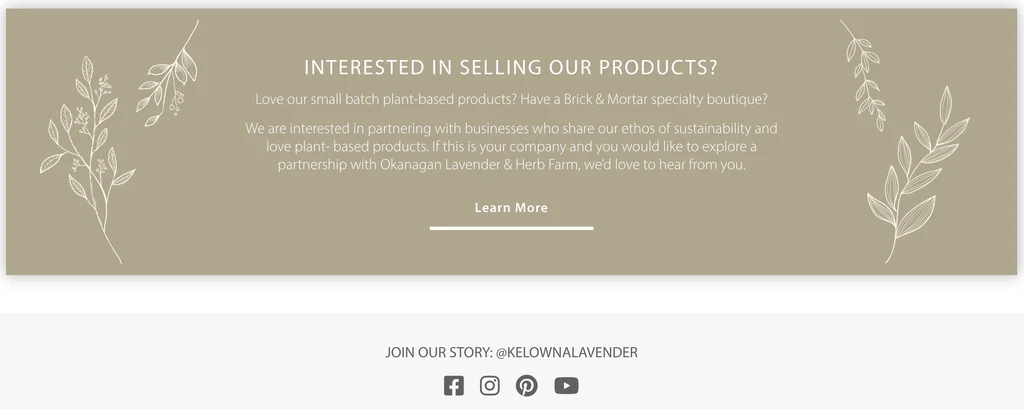
Vacationers tend to get really, really excited about their trips. That naturally makes them want to tell everyone they know about the fun and wonderful items on their itinerary. Let your fans rave about you: word of mouth is powerful (and free!).
Back in 2016, we pointed to the share buttons on Okanagan Lavender’s website. Share buttons still help, but in 2026 the bigger wins are tagged posts and reviews. As James put it on our podcast, reviews “can’t be ignored anymore.”
- Show your Instagram handle and a hashtag on your website, your confirmation emails and your on-site signage.
- Send a one-click Google review link in your post-visit email, while the experience is still fresh.
- Respond to every review, the good and the bad. Our Google Business Profile guide covers how.
- Put your best reviews right beside your “Book Now” button, where people decide.
If keeping up with reviews and posts feels like a second job, our online reputation and reviews and social media management services take it off your plate.
5. Measure What Your Tourism Website Is Doing
Are your marketing dollars hard at work or hardly working? You can’t improve what you don’t measure. Keeping with our guest services analogy, your website needs its own heart-to-heart behind closed doors sometimes. What’s working, what’s not working, and how can you as a manager help it succeed? Your analytical data is a gold mine, sometimes quite literally.
Running a tourism business without tracking is like running a marina without counting the boats. You’ll find out something’s missing, just a little later than you’d like.
The questions haven’t changed since 2016:
- Which marketing campaigns are working best?
- Where should your budget go?
- Which pages do your guests visit most, and least?
- Where do your visitors live, and what language do they speak?
The tools have. Today, that means Google Analytics 4 (GA4) with bookings and calls set up as tracked events, plus phone call tracking so you know which ad or listing made the phone ring. At Twin Creek Media, our Data Analyst rolls this into monthly performance reports that show the best and worst results side by side.
| Track this | Why it matters |
|---|---|
| Completed bookings | The number that pays the bills, tied to the channel that brought each one |
| Calls from your website | Many guests still want to talk before they book |
| Mobile vs. desktop booking rate | A low mobile rate usually points to a booking flow problem |
| Top landing pages | Shows which experiences and offers pull people in |
| Traffic sources | Tells you where to put more budget, and where to pull back |
6. Get Found Where Kelowna Tourism Guests Search Now
In 2016, getting found mostly meant ranking on Google. It still does, but now it also means showing up in Google Maps and in AI tools like ChatGPT and Google’s AI Overviews, which summarize answers before anyone clicks.
- Keep your Google Business Profile complete: hours, current photos and a direct booking link.
- Answer real guest questions on your site in plain language: what it costs, how long it takes, and what to bring. Clear answers are what search engines and AI tools pull from.
- List with your local tourism association and partner sites. Our post on tourism advertising ideas covers more ways to do this.
Our search engine optimization and GEO and AI search services are designed to keep all these aspects in check.
What This Looks Like For a Real Tourism Client
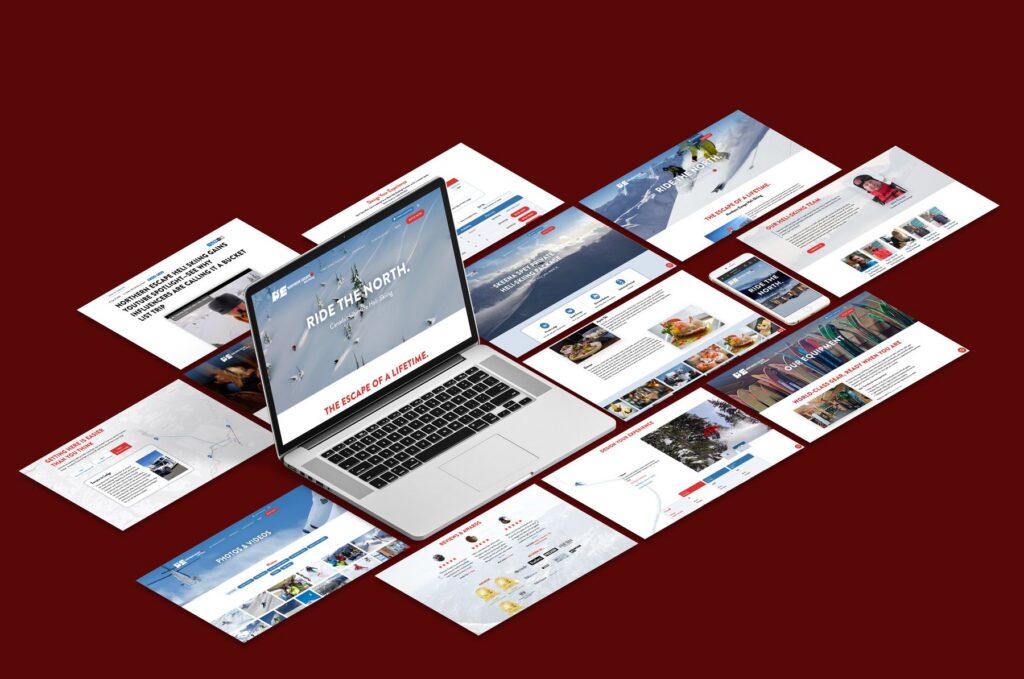
Northern Escape Heli-Skiing runs a remote heli-ski operation, so its website has to sell the trip to skiers who may live on another continent. As their tourism marketing agency, TCM ran international campaigns that put them in front of serious skiers in more than 50 countries. Website visitors grew 400%, and their marketing returned 19x.
“Twin Creek Media takes care of everything for us, from social media management to Google ads and marketing. They brought it all together under one roof, in one budget, in one place, and it just makes my life much easier.”
— John Forrest, President, Northern Escape Heli-Skiing
What Now?
Your tourism website should work like your best guest services staff: welcoming, quick with answers, and always ready to take a booking. Get the emotion, the CTA, the mobile experience, the reviews and the measurement right, and your website earns its keep season after season.
Want to see how your numbers stack up? Get our free tourism marketing funnel guide: real annual numbers from a tourism client like you, the common leaks, and what to fix first.
Still running a plain vanilla tourism website? We’d love to help you fix that before next season.
Twin Creek Media can be your marketing partner for measurable growth, helping Okanagan tourism operators turn website visits into direct bookings through strategy, website design and advertising. Start a conversation with our team today.