
Original post Apr 1, 2016 | Updated by Kristina Blancher Oct 27, 2026
Your website is more important than ever. It’s the online representative of your entire organization. It’s your go-getter salesperson. It’s the customer service gateway. It has a lot depending on it so it better be amazing! Twin Creek Media believes in crafting great website experiences. That starts with our very first meeting with you, long before any customer sees it.
As a website design company in Kelowna that businesses trust to build their online presence for marketing and sales, we often get asked, ‘How long does it take to build a website?’ Our projects vary from 6 weeks to 9 months, since it depends on the complexity, amount of feedback, and mid-project extras. However, there is a process that naturally unfolds as we walk our clients towards the finished product that:
- Increases site traffic through great search engine optimization
- Convert leads into sales
- Acts as your online brand ambassador
- Serves as a customer service gateway
- Look fantastic!
From the time we first begin discussing your vision for a website to the time it’s launched to the public, a typical project for the small and mid-sized businesses we work with in Kelowna takes about 3 months. Smaller sites are up in a matter of weeks, whereas large overhauls with 100s of pages of content to consider take the better part of a year. That might seem like a long time, but as you’re about to see, there’s a lot that goes into it. Here’s how a typical project breaks down: 3 weeks for the blueprint, 3 for the visuals, 6 for development, and 2 for launch.
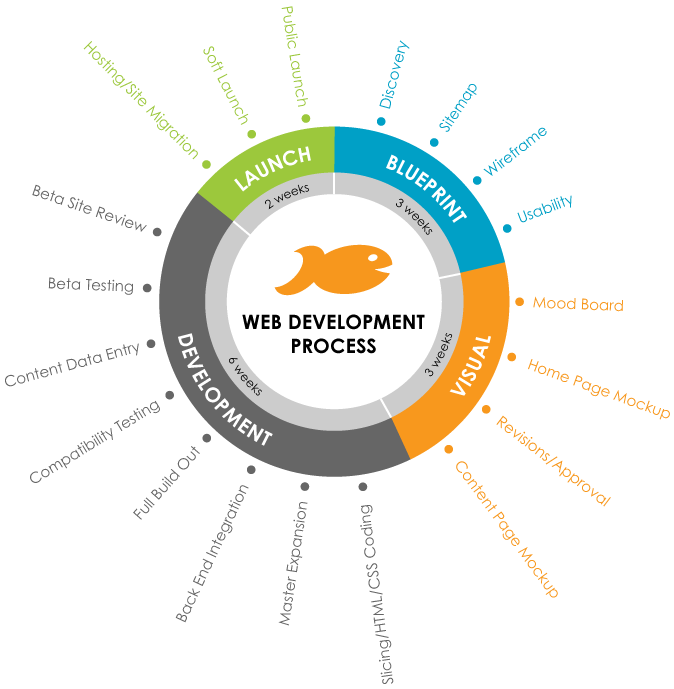
A goal without a plan is just a wish. Good websites start with a good process.
Blueprint
Similar to a blueprint for constructing a new home, a website needs to be mapped out beforehand. This gives the team of project managers, developers, graphic designers and content writers something to guide them along the way. It all begins with client meetings to learn:
- Based on the target audience, what does the website need to accomplish?
- How should the site be organized?
- What are the special features and functions needed?
- What is the content strategy?
- What are the key calls to action and how will the goals be measured?
Once these criteria are established, the next step is to create a sitemap and writing plan based on your input. This includes creating page schematics (also known as wireframes) to give you a skeletal framework for what your website will look like. Keep in mind that developing websites is meant to be a collaborative process for the client. That’s why it matters to work with a Kelowna website company that other business owners are happy to recommend. Are you in the tourism business? Check out our post on the features we’d discuss in the blueprint phase if you’re looking to boost bookings: Get More Bookings From Your Website.
Visual
After an introduction of design options and various approaches to page layout, we like to study your competitors’ websites and walk through your likes and dislikes. Inevitably you will discover hidden gems that you’d like to integrate and things that you want to avoid. We will challenge your assumptions (with a smile) to give options to consider, like these examples of websites we love.
Art is personal. The design also brings out personal preferences. It’s important to remember though that your users come first. Since usability is closely related to design, everything needs to be viewed through your customer’s eyes. Once the top-level organizational details of your website are fleshed out, and we’ve narrowed down the overall look and feel, we’ll design some visual mockups in Figma. This is a fun and collaborative stage. Enjoy the process!
Development
When the visuals, artwork, graphics, and content are all approved, the site is ready to enter the Matrix… you know the screen with all the code flowing like a river of numbers and letters? During the website development stage, the content management system is built out with all the pages. We’ll use whatever fits your project, but we default to WordPress, Shopify, Squarespace, or some combination. Every website we build is built with the following great features in mind:
- Your new website will be beautifully designed just the way you want it.
- It will always look great on any computer, tablet, and phone.
- Scalable: your website is powerful and flexible, so it can grow with you.
- No special hardware needed and no expensive licences to buy.
- Easy to use: training and a user guide are included.
- Built for speed: professionally hosted in secure data centres.
- All web statistics are measured, and Google Analytics 4 is included.
- Regular, automatic backups.
- Art + Science + Passion = Results.
Looking good on a phone is not optional anymore. Google ranks sites using their mobile version, so compatibility testing covers phones and tablets as well as desktops.
Great website design and smart functionality support your goals, becoming your extra salesperson.
Launch
And finally, the moment you’ve been waiting for: launch day. Before we make it official, we like to try a soft launch to see if there are any quirks that need to be worked out. Usability issues are addressed, and technical tasks like redirect tables, XML sitemap submission, and search engine updates are made. Google Analytics 4 is set up. Then the worldwide launch. Ribbons are cut. Champagne is poured. Now breathe… you’re done. For now.
FAQ
Q: How long does it take to build a website?
A: Projects vary from 6 weeks to 9 months, depending on complexity, the amount of feedback, and mid-project extras. A typical website for a small or mid-sized business takes about 3 months, or roughly 14 weeks: 3 for the blueprint, 3 for the visuals, 6 for development, and 2 for launch.
Q: What are the stages of a website design project?
A: Four. The blueprint covers discovery meetings, the sitemap, and wireframes. The visual stage covers design options, competitor review, mockups, and revisions. Development builds out the pages, content, and testing. Launch covers the soft launch, redirects, XML sitemap submission, analytics, and the public launch.
Q: What platform will my website be built on?
A: We’ll use whatever fits your project, but we default to WordPress, Shopify, Squarespace, or some combination of the three.
Q: What do I need to have ready before a website project starts?
A: A clear idea of who the site is for and what it needs to do. In the blueprint meetings we work through your audience, goals, features, content strategy, and key calls to action together.
Q: What happens after my new website launches?
A: Launch day is the start, not the finish. After the site goes live we’re ready to keep going with integrated marketing campaigns, and our website maintenance team can keep it running smoothly.
About James Shaw
James Shaw is the Founder and CEO of Twin Creek Media (TCM), a Kelowna-based full-service marketing agency he built from the ground up in 2004. Over 22 years, TCM has grown into a team of 12, serving clients across BC, Canada, and the US.
Twin Creek Media can be your marketing partner for measurable growth. Many companies in Western Canada treat us like their marketing department, and a new website is often where that partnership starts. Our website design services take you from blueprint to launch day, and our advertising team keeps it growing after. Start a conversation with our team today or call 1-250-762-4001.